By Raphael, Founder of Heavy Duty Mobility. Reviewed and updated June 13, 2026. Meet the HDM team.
What is a motorized gas cylinder cart
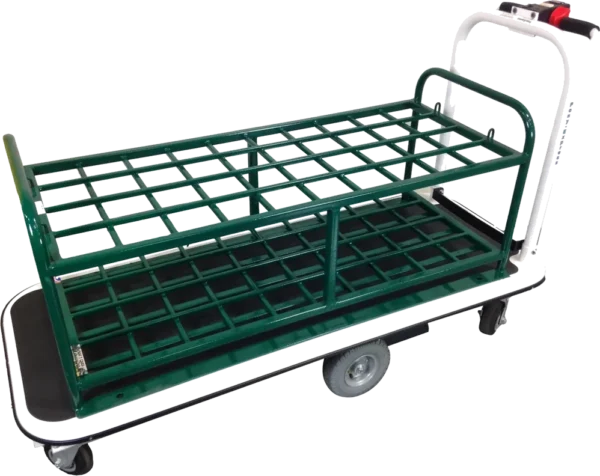
A motorized gas cylinder cart is a powered rack that carries multiple compressed gas tanks and drives itself under battery power while one operator steers. The Pony Express version holds 24, 32, 40, or 48 small-format cylinders and moves loads up to 2,000 lb at 0 to 3 mph. The operator simply walks behind it and steers. There is no lifting, no shoving a dead-weight rack across a polished floor, and no two-person tank shuffle down a corridor.
The reason to power the rack comes down to weight. A full E cylinder runs close to 13 to 15 lb, but the larger cylinders in a hospital gas room are far heavier, and a packed 48-tank rack can approach the 2,000 lb ceiling. Moving that by hand is exactly where back injuries and dropped tanks happen. A powered cart turns the whole thing into a steering job.
Powered Medical Gas Cylinder Carts
Move 24 to 48 Cylinders Without the Push
One walk-behind powered rack hauls up to 2,000 lb of oxygen and medical gas across the facility
Headline spec
Up to 48 Cylinders per cart
- 2,000 lb Max load capacity
- 10 mi Range per charge
- 0 to 3 mph Walk-behind speed
- 5 yr Frame and motor warranty
- $4,549 Sale price (reg $5,282)
Cylinder capacity by configuration
- 24-cylinder 24
- 32-cylinder 32
- 40-cylinder 40
- 48-cylinder 48
Built for
- Hospitals moving oxygen cylinders between storage and patient floors
- Clinics and surgery centers restocking medical gas supply rooms
- Gas distributors loading and rotating cylinder inventory
- Facilities replacing manual push carts to cut strain and dropped-cylinder risk
A powered center-wheel-drive rack rated to 2,000 lb on a 6 degree incline, so one person can move a full 48-cylinder load that would otherwise take a team to push.
Who buys a powered cylinder cart
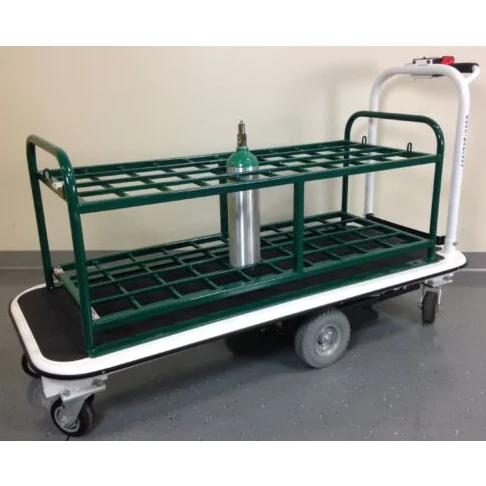
The powered rack holds 24 to 48 oxygen and medical gas cylinders upright and moves them as one load.
Hospitals, surgical centers, clinics, and medical gas distributors are the core buyers. Anyone who moves oxygen, nitrous oxide, or medical air cylinders between a bulk storage room and the point of use needs to do it without tipping a tank or straining a worker. The same cart works just as well for industrial gas suppliers cycling argon, CO2, and nitrogen tanks through a warehouse. Healthcare facilities also store and move these cylinders under the NFPA 99 Health Care Facilities Code, which governs medical gas handling on site.
The factor that really decides the model is how many cylinders you move per trip. A small clinic relocating a handful of E tanks does not need the 48-cylinder XL, while a distributor staging a full rack for delivery does. Pick the capacity for the busiest run you make, not the average one.
How many cylinders does it hold
The Pony Express cart comes in four capacities, and they all share the same powered base. The 24-cylinder model is the standard build. From there you step up to 32, 40, or 48 cylinders by model code, and the larger racks cost more because they carry more steel and take up a bigger footprint.
- 24 cylinders – the base MGC-S24C build, the most common pick for clinics and smaller gas rooms.
- 32 cylinders – the MGC-M32C, a modest step up for busier departments.
- 40 cylinders – the MGC-L40C, for distributors and large facilities.
- 48 cylinders – the MGC-XL48C, the full rack for high-volume staging.
Every model fits M7, M9, C, D, and E small-format medical gas tanks and carries up to 2,000 lb total. The cylinder count sets the rack geometry, and the 2,000 lb load rating is the hard ceiling. Do not exceed it by stuffing larger tanks into a frame that was counted for smaller ones.
How to keep cylinders upright and secured
Compressed gas cylinders have to travel upright and restrained, because a cylinder that tips and shears its valve becomes a projectile. The Pony Express rack holds each tank in its own slot, and you secure the rack with the chain or strap restraint before moving. Both OSHA guidance on securing compressed gas cylinders on portable carts and the Compressed Gas Association cylinder handling guidance require cylinders to be secured during transport and storage, with valve caps on and never loose in a pile. The federal rule behind that is OSHA 1910.101 compressed gases standard, which sets the baseline for handling and storing gas cylinders in the workplace.
Raphael’s rule for cylinder transport. Every cylinder rides upright with its valve protection cap threaded on, and the rack restraint goes chained across the front row before the wheels ever move. We push the cart and we never pull it, so the operator stays behind the load and can see where it is going. On the 6-degree grade limit, take ramps straight on at low speed and let the automatic holding brake catch you if you stop. The brake locks the instant you release the throttle, which is exactly what you want on an incline with 2,000 lb of oxygen behind you. I have watched a manual rack get away from one person on a 1-in-12 dock ramp. With the powered cart that does not happen, because the cart holds itself.
Why powered beats pushing it by hand
A loaded cylinder rack is well past what one person should ever push. The NIOSH ergonomic guidelines for manual material handling put the sustained push force a worker should handle at roughly 50 lbf, and a 2,000 lb rack on casters needs far more than that just to start and steer, especially over a floor transition or up a grade. That gap is where strains, dropped tanks, and pinched hands come from. Powering the rack removes the force entirely, so the operator steers at 0 to 3 mph and the motor does the work.
The cart runs on deep-cycle AGM batteries with an on-board UL and cUL listed smart charger that plugs into any 100 to 240 VAC outlet. You get about 10 miles per charge, which is enough for a full shift of gas-room runs, and you top it up overnight. Regenerative braking on deceleration and descent feeds charge back into the battery and keeps the cart from running away downhill.
Our top pick
Our pick is the Pony Express Motorized Medical Gas Cylinder Cart, because it is the only model we stock that is built specifically for moving a full rack of medical gas under power. It is on sale at $4,549, down from $5,282. The 24-cylinder base build suits most clinics and gas rooms, and you can order the 32, 40, or 48-cylinder rack when you move more tanks per trip. It carries up to 2,000 lb, fits M7, M9, C, D, and E tanks, and ships with a 2-year frame and drive warranty.
If you only ever move a single cylinder bedside, this is more cart than you need, and a manual single-tank dolly is the right buy. We sell the powered 2,000 lb rack for facilities cycling many tanks a day. For other healthcare transport jobs around the same floor, see our hospital and healthcare motorized carts and the motorized linen and laundry carts for soiled-linen rounds.
Things to know before you order
The cart is US-built by EK Tech in the Pony Express line and backed by a 2-year frame and drive warranty. It includes a keyed switch, horn, and e-stop, so an unauthorized hand cannot drive it off. The standard build is the 24-cylinder MGC-S24C, and the larger racks are a model-code upgrade at order time. Every Pony Express unit qualifies for the 21-day manufacturer demo program, so you can run one in your own gas room before you commit. This page sits inside our wider motorized carts range if you also move platforms, linen, or general loads under power.
Lead times, freight, and the right cylinder count are all worth a quick call before you order. We confirm the tank sizes you actually move and the busiest run you make, then match the rack to it.




 4.7
4.7